
Posted by Blue Thumb Water Feature Team on Jul 15th 2026
How to Choose a Water Fountain That Actually Fits Your Space
Last updated: July 2026
Quick answer: The right outdoor fountain should fit the scale of your space, remain visible from your main viewing area, produce an appropriate amount of sound, and leave enough room for the basin, splash, electrical connection, and routine maintenance. Measure the complete operating footprint—not just the decorative fountain you see above ground.
The right outdoor fountain is not simply the largest fountain that will physically fit in your yard. It should fit the scale of the space, remain visible from your main viewing area, produce an appropriate amount of sound, and leave enough room for the basin, splash, electrical connection, and routine maintenance.
Before buying, measure the fountain’s complete operating footprint—not just the decorative vase, rock, sphere, bowl, or column you see above ground.
How to Choose an Outdoor Fountain
- Measure the usable width, depth, and height of the installation area.
- Check the complete fountain-kit dimensions, including the basin, bowl, or pebble area.
- Leave comfortable room for walking, maintenance, and expected splash.
- Match the water sound to how the area will be used.
- Confirm that the location has a level base and safe access to electricity.
- Make a full-size temporary outline before ordering.
- Choose a complete kit with a properly matched basin, pump, and plumbing.
A fountain that fits correctly should look intentional from the primary viewing area without blocking walkways, doors, windows, landscaping, or seating.
Start with the Fountain’s Full Footprint
One of the most common mistakes is shopping according to the height or diameter of the decorative fountain alone.
The visible fountain may sit on a much wider bowl, underground reservoir, or pebble-covered basin. That wider area is the fountain’s actual footprint.
For example, Blue Thumb’s 14-inch Crystal Sphere Fountain Kit has:
- A 14-inch-diameter sphere
- An overall fountain height of 22.75 inches
- A 24-inch-diameter steel bowl
The larger 24-inch Crystal Sphere Fountain Kit has:
- A 24-inch-diameter sphere
- An overall fountain height of 33 inches
- A 48-inch-diameter steel bowl
The visible sphere grows by only 10 inches, but the supporting bowl doubles from 24 to 48 inches in diameter. This is why product photography alone can be misleading when you are judging scale.
Before ordering any fountain, confirm:
- Overall fountain height
- Widest visible point
- Basin, bowl, or reservoir dimensions
- Finished pebble or splash area
- Fountain weight
- Required installation clearance
- Pump-access location
Outdoor Fountain Size Guide
The following ranges are useful starting points, especially when comparing outdoor vase fountains. They are not strict design rules. The correct choice still depends on the fountain’s width, basin size, surroundings, and viewing distance.
| Fountain height | Good starting locations | What to watch |
|---|---|---|
| Under 29 inches | Small patios, courtyards, porch accents, narrow beds, garden seating areas | A short sphere, bowl, or rock fountain may still have a wide footprint. |
| 30 to 39 inches | Standard patios, front walks, medium courtyards, entryway landscaping | Confirm that furniture, railings, or plants will not hide the fountain. |
| 40 to 49 inches | Larger patios, open beds, prominent entryways, backyard seating areas | Compare the height with nearby windows, shrubs, furniture, and architectural features. |
| 50 to 59 inches | Large landscape beds, open lawns, driveways, commercial entrances, large courtyards | Tall fountains need visual breathing room and may require additional installation planning. |
| Triple or multi-piece | Wide beds, courtyard centerpieces, large patios, commercial properties | Measure the complete arrangement and basin—not each piece separately. |
Under 29 Inches Tall
Compact fountains can create a noticeable focal point without visually crowding furniture or walking areas. They are often easier to integrate near an existing garden bed or patio.
Do not assume every short fountain has a small footprint. A low sphere, wide bowl, or spreading rock formation may require more ground space than a taller, narrower vase.
30 to 39 Inches Tall
This range is substantial enough to become a focal point while remaining comfortable in many residential landscapes. It is often a good starting point when you want the fountain to be noticed without dominating the entire area.
40 to 49 Inches Tall
A fountain in this range has stronger vertical presence. Check its height against nearby windows, railings, furniture, and plants so it does not disappear behind the landscaping or block an important view.
50 to 59 Inches Tall
Tall fountains need breathing room. A fountain that looks appropriately scaled in an open yard may feel oversized when placed immediately beside a small dining table or narrow walkway.
Triple and Multi-Piece Fountains
Triple fountains create width, depth, and movement. Measure the complete arrangement rather than measuring each individual piece separately. Include the distance between pieces and the entire basin or pebble area. You can also browse Blue Thumb’s triple vase fountain sets.
Use This Five-Minute Measuring Method
1. Identify the Main Viewing Area
Decide where people will see the fountain most often. That may be a patio chair, kitchen window, front walkway, driveway, garden path, or business entrance.
The fountain should be sized for this view, not only for the spot where it will sit. A small fountain can disappear when viewed across a large yard, while a large fountain can feel overwhelming when viewed from only a few feet away.
2. Measure the Maximum Usable Footprint
Measure the width and depth of the space that can actually be used without interfering with:
- Doors and steps
- Walkways
- Seating and grills
- Railings
- Irrigation
- Downspouts
- Utility equipment
- Plant growth
- Pump access
Do not use the entire empty area as the fountain footprint. Preserve enough room for the space to remain functional.
3. Check the Height
Compare the proposed fountain height with nearby objects.
A fountain placed against a blank wall may need more height than one placed beside a chair or low garden border. A fountain surrounded by mature shrubs must be tall enough to remain visible after the plants fill out.
Avoid unintentionally blocking windows, address numbers, architectural details, landscape lighting, or views from inside the home.
4. Build a Temporary Mockup
Use cardboard boxes, a trash can, plant stakes, painter’s tape, or a large piece of poster board to recreate the proposed height and width.
Outline the basin or pebble area with a garden hose, rope, marking paint, tape, or small flags. View the mockup from every important angle and take a phone photo from the patio, window, walkway, and driveway.
5. Add the Practical Clearance
Make sure you can reach the pump-access point and clean around the fountain. Leave enough room so expected splash does not constantly wet doors, windows, siding, furniture, or the primary walking path.
Exposed and windy locations generally require more consideration than protected courtyards.
Match the Fountain Style to the Shape of the Space
Vase and Urn Fountains
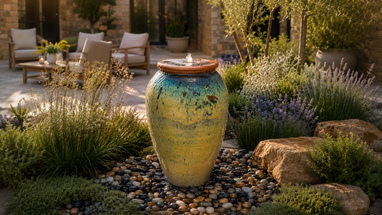
Vase fountains provide strong vertical interest without necessarily requiring a massive visual footprint. They work well in patios, courtyards, entryways, narrow beds, garden corners, and spaces beside columns or walls.
Blue Thumb vase fountains are available in multiple heights, colors, and silhouettes. A tall, narrow vase can fit a space differently than a short, wide urn, even when both have similar overall dimensions.
Closed-top vase fountains usually create a more modest plume and subtle water presentation. Open-top vase fountains fill before overflowing and generally produce more flow and sound.
GFRC Rock Fountains
GFRC bubbling boulders are a good option when you want a natural appearance without using a massive piece of solid stone. They fit especially well in naturalistic landscapes, mulched beds, woodland-style gardens, and informal patios.
Single-rock fountain kits can fit smaller spaces, while triple-rock arrangements need additional width and become stronger landscape focal points.
Real Stone Fountains
Real stone fountains provide natural variation, texture, and substantial visual weight. They are well suited for permanent focal points, contemporary or naturalistic gardens, open patios, commercial entrances, and large beds.
Because natural stone can be extremely heavy, plan the installation route and foundation before delivery. Confirm that equipment and labor can reach the final location. Blue Thumb also offers single stone fountain kits and shaped stone fountains.
Triple Fountains
Triple fountains are useful when a single vertical object would look too narrow for the available area. Multiple heights create a layered composition and stronger movement.
They work well in broad spaces but can overwhelm a narrow side yard or small seating area. Check the full arrangement width and reservoir size.
Tiered Fountains
Tiered fountains create a traditional, formal appearance and usually produce more visible falling water. They are often best in courtyards, circular drives, formal gardens, large patios, symmetrical landscapes, and entry plazas.
Because water falls from one level to another, consider splash, wind, and walking clearance carefully.
Metal and Modern Fountains
Metal fountains, reflection bowls, sculptural trees, and modern sphere fountains can function as both moving water and outdoor art.
These are appropriate when you want the fountain to contrast with the landscaping rather than blend into it. Give highly sculptural fountains enough open space to be seen clearly.
Choose the Right Amount of Water Sound
Fountain size does not automatically determine sound. The way the water moves is often more important.
Sound is affected by:
- Water-flow rate
- Drop height
- Number of water outlets
- Surface texture
- Whether water bubbles, sheets, spills, or falls
- The surface where the water lands
- Surrounding walls and hardscape
- Pump adjustment
- Background noise
Choose gentler water movement for reading areas, small enclosed patios, conversation spaces, locations near bedroom windows, and quiet courtyards.
Choose more pronounced water movement for larger entertainment patios, areas with road noise, commercial entrances, spaces viewed from farther away, and locations where sound is a primary goal.
An open-top vase generally creates more flow and sound than a comparable closed-top vase. Cascading and tiered fountains also tend to create more audible water than a gentle bubbling feature.
When possible, watch a product video with the volume on before ordering. Remember that phone and computer speakers cannot perfectly reproduce the actual sound level.
Consider Splash, Wind, Sun, Power, and Placement
Splash and Water Loss
Every outdoor fountain loses some water through evaporation and splash. The amount varies with the fountain design and site conditions.
Water may need to be added more frequently when the fountain is:
- In full sun
- Exposed to wind
- Producing a tall plume
- Creating multiple drops
- Installed near heat-reflective hardscape
- Operated during hot or dry weather
Avoid placing a high-flow fountain where prevailing wind will regularly carry water onto furniture, doors, walkways, or siding.
A wider basin, correctly adjusted flow, fountain apron, or protected location can help reduce water loss. Compatible fountain accessories and auto-fill components may also be useful.
Electricity and Water
Most recirculating outdoor fountains do not require a permanent water supply. The pump continually circulates water stored in the basin or reservoir. You initially fill the system and then add water periodically to replace evaporation and splash.
The fountain will generally need access to a properly installed outdoor GFCI-protected electrical outlet. Do not rely on an unsafe extension-cord arrangement as a permanent power source.
Before installation:
- Confirm the pump-cord length
- Locate the nearest suitable outlet
- Plan how the cord will be concealed and protected
- Follow the product instructions
- Follow applicable electrical requirements
- Hire a qualified electrician when a new outlet is needed
An optional auto-fill system can reduce manual top-offs, but compatibility and installation requirements should be verified for the specific fountain.
Patios and Decks
Many fountains can be installed on a patio when the surface is level, stable, and able to support the completed system.
Remember that the operating weight includes the fountain, basin or bowl, water, pebbles or decorative stone, and support components.
For an elevated deck, balcony, or rooftop, do not assume the structure can support the fountain based only on the product’s empty weight. Have the load capacity and installation plan evaluated by a qualified professional.
Also consider drainage and splash. A fountain should not create a recurring slipping hazard or direct water toward the building.
Choose Materials for Appearance and Installation
Ceramic and Glazed Vases
Best for color, distinctive finishes, and traditional or contemporary patio designs. Follow winter-protection recommendations carefully in freezing climates.
GFRC
Provides the appearance and texture of natural stone with less weight than many comparable solid-rock pieces. It works well in naturalistic landscapes.
Real Stone
Offers unique color and natural variation. It creates a substantial, permanent focal point but requires more planning for transport and installation.
Metal
Suitable for contemporary, rustic, artistic, or architectural designs. Some metals and finishes are intended to weather or develop a patina.
Cast Stone
Often used in traditional tiered and pedestal fountains. It provides a classic appearance and significant visual presence.
Acrylic
Creates a clean, modern effect and can pair especially well with fountain lighting. Acrylic spheres can be visually compact, but the supporting bowl or basin may be considerably wider.
Why a Complete Fountain Kit Is Usually Easier
A fountain is a complete operating system, not just a decorative object. The basin must hold enough water, the pump must provide the correct flow at the required height, and the plumbing must fit the pump and fountain.
A complete Blue Thumb fountain kit is designed to reduce component-matching problems by pairing the fountain with the appropriate:
- Basin or reservoir
- Fountain pump
- Tubing
- Valves
- Connections
- Installation components
Product-specific inclusions can vary, especially for lighting, finishing materials, and optional accessories, so always review the individual product page before ordering.
Maintenance Questions to Consider Before Buying
- How easily can I reach the pump?
- How often will leaves fall into the area?
- Will the fountain be exposed to full sun?
- Can I comfortably add water?
- Is the basin large enough for the fountain’s flow?
- Do I want an auto-fill system?
- Will I use a fountain water treatment?
- How will the fountain be protected during winter?
- Can the fountain be covered without trapping water?
- Can heavy components remain safely in place year-round?
Routine care typically includes checking the water level, removing debris, inspecting the pump, cleaning fountain surfaces, and following seasonal shutdown instructions. Consult the applicable Blue Thumb installation manual for product-specific guidance.
Common Fountain-Sizing Mistakes
Measuring Only the Decorative Fountain
The basin, bowl, reservoir, or pebble area may be much wider.
Choosing from Close-Up Product Photos
A product photographed by itself can appear larger or smaller than it will in your landscape. Always verify dimensions.
Ignoring the Primary Viewing Distance
A fountain that looks ideal from five feet away may disappear when viewed from across the yard.
Blocking Movement
Do not reduce a comfortable walkway to an awkward path around the fountain.
Ignoring Mature Plant Size
New landscaping may grow around and eventually hide a fountain that is already too small.
Forgetting Pump Access
A beautiful installation becomes frustrating when the pump cannot be reached without dismantling the entire feature.
Choosing Sound After Size
A physically appropriate fountain can still be wrong for a space if its water sound is too quiet or too energetic.
Buying Unmatched Components
An incorrectly sized pump or reservoir can result in poor flow, excessive splash, frequent refilling, or difficult maintenance.
Outdoor Fountain Buying Checklist
- Fountain height
- Fountain width and depth
- Complete basin or bowl dimensions
- Finished pebble-area dimensions
- Empty and operating weight
- Main viewing distance
- Walking clearance
- Expected splash
- Wind exposure
- Sun exposure
- Electrical access
- Pump access
- Water top-off plan
- Winterization requirements
- Included kit components
- Delivery and installation route
If all of these items work for the location, the fountain is much more likely to feel like a natural part of the landscape.
Frequently Asked Questions
How big should an outdoor fountain be?
It should be large enough to remain visible from the primary viewing area but small enough to preserve comfortable movement and visual balance. Measure the entire fountain system, including its basin or pebble area, rather than choosing according to height alone.
What size fountain is best for a small patio?
Compact fountains under approximately 29 inches tall can be a useful starting point. Narrow vase fountains and small bubbling rocks often use visual space efficiently. Always check the actual basin dimensions before deciding.
Should a fountain be taller than nearby furniture?
It does not have to be, but a fountain that is partially hidden behind chairs, tables, railings, or plants may lose its impact. Use a temporary mockup to compare the proposed height with surrounding objects.
How much room should I leave around an outdoor fountain?
Leave enough room for comfortable walking, pump access, cleaning, and expected splash. The required amount depends on the fountain’s flow, wind exposure, and location. Avoid placing the fountain where water will repeatedly wet a doorway, seating area, or main path.
Do outdoor fountains need plumbing?
Most recirculating fountains do not need a permanent water line. They reuse water held in the basin and require periodic top-offs. Compatible auto-fill systems can automate water replacement.
Do outdoor fountains need electricity?
Most pump-operated fountains need a suitable outdoor electrical connection, typically a GFCI-protected outlet. Follow the product instructions and applicable electrical requirements.
Are outdoor fountains difficult to install?
Many complete fountain kits are designed for homeowner or professional installation, but difficulty depends on the fountain’s weight, foundation, basin size, electrical access, and delivery route. Large real-stone and multi-piece fountains may require professional equipment or labor.
Can I put a fountain on concrete?
Yes, provided the surface is level, stable, properly located, and capable of supporting the complete operating weight. Plan for splash and drainage.
How loud will an outdoor fountain be?
Sound depends more on water movement than overall fountain size. Open-top, cascading, and tiered fountains generally produce more sound than modest closed-top or gently bubbling fountains.
How often do I need to add water?
That depends on heat, wind, sunlight, fountain flow, basin capacity, and splash. Check the water level regularly, especially during hot or windy conditions. Never allow the pump to operate without enough water.
How do I keep fountain water clean?
Remove debris, maintain the proper water level, clean the pump as needed, and use a treatment approved for the fountain’s material and intended environment. Follow all product directions.
Do outdoor fountains need to be winterized?
Fountains in freezing climates generally require seasonal preparation. The exact steps depend on the fountain and pump. Follow the manufacturer’s instructions for draining, pump storage, covering, and freeze protection.
Should I buy a complete fountain kit?
A complete kit is usually the simplest option because the fountain, basin, pump, and plumbing are selected to work together. It reduces the risk of ordering a reservoir that is too small or a pump that cannot provide the intended flow.
Find the Fountain That Fits
The best outdoor fountain is not necessarily the smallest or largest option. It is the fountain whose height, complete footprint, sound, style, and maintenance needs match the way you actually use the space.
Blue Thumb offers vase fountains, natural-looking GFRC rocks, real stone fountains, triple arrangements, tiered fountains, metal water features, and modern sphere fountains in a wide range of sizes.
Begin by measuring your space, outlining the complete footprint, and viewing a temporary mockup from the locations where you will enjoy the fountain most. That small amount of planning can prevent an expensive sizing mistake and help your new water feature feel as though it was designed for the landscape from the beginning.
Need Help Choosing?
Browse all Blue Thumb fountain kits, call the Blue Thumb team at 888-619-3474, or connect with a water-feature professional.
About Blue Thumb
Blue Thumb has spent more than 25 years helping homeowners, landscape professionals, and water-feature enthusiasts design, install, and maintain water features. Many Blue Thumb products are manufactured at the company’s facility in Saginaw, Michigan. Learn more about Blue Thumb.